
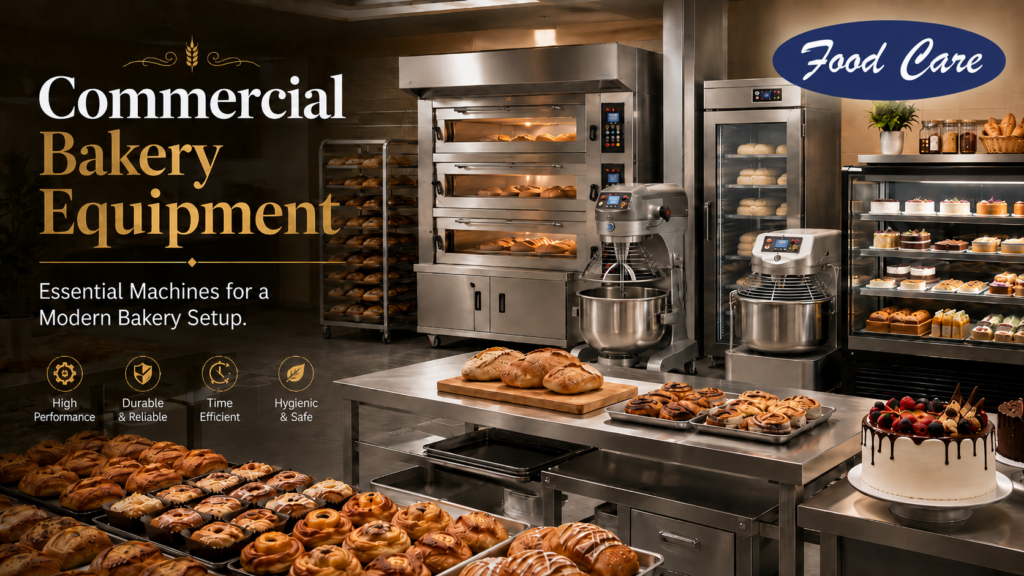
Commercial Bakery Equipment: Essential Machines for a Modern Bakery Setup
Running a successful bakery requires much more than good recipes and skilled bakers. Whether you operate an independent bakery, café, hotel pastry kitchen, QSR, sweet shop, central production kitchen, or large food-service operation, the quality of your commercial bakery equipment directly affects production speed, consistency, hygiene, labour efficiency, and the quality of the final product.
Modern bakeries need equipment capable of handling repetitive production without compromising texture, taste, appearance, or food safety. Domestic appliances may work for small batches, but once production increases, professional bakery machines become essential.
From mixing and dough preparation to baking, refrigeration, storage, and product display, every stage of bakery production depends on the right equipment. A properly planned bakery setup can help reduce unnecessary movement, improve workflow, and allow staff to handle larger volumes more efficiently.
At Foodcare, commercial kitchen equipment, bakery solutions, customized fabrication, and kitchen planning can be combined to create a setup according to the operational requirements of the business.
Explore professional food service and bakery solutions from Foodcare.
1. Why Commercial Bakery Equipment Is Essential for a Professional Bakery
A commercial bakery can produce dozens or even hundreds of items every day. Cakes, breads, cookies, pastries, muffins, buns, desserts, and confectionery products often require different preparation methods, temperatures, and storage conditions.
This is why choosing appropriate commercial bakery equipment should be one of the first steps when planning a bakery.
Professional equipment is designed for repeated use and higher production volumes. Instead of preparing several small batches, a bakery can process larger quantities while maintaining more consistent results.
Consistent Product Quality
Customers expect their favourite bakery products to taste and look the same every time they visit. Commercial mixers, ovens, proofers, and temperature-controlled equipment make it easier to standardize recipes and production processes.
Consistency becomes particularly important when a bakery has multiple outlets or supplies products to cafés, restaurants, hotels, or retail stores.
Faster Production
Production speed directly influences the number of orders a bakery can handle.
A suitable dough mixer can prepare larger quantities in one cycle, while commercial ovens can bake multiple trays simultaneously. Refrigeration equipment can keep ingredients organized and ready for production, reducing unnecessary delays.
Better Workflow
A bakery should ideally follow a logical production flow:
Ingredient storage → preparation → mixing → shaping → proofing → baking → cooling → finishing → refrigeration or display.
When the equipment is positioned according to this workflow, staff spend less time carrying ingredients and products from one end of the kitchen to another.
Hygiene and Easy Maintenance
Stainless-steel bakery equipment is widely used in professional food-service environments because it is durable, easy to clean, and suitable for hygienic food preparation.
A well-designed bakery setup also creates enough space around equipment for cleaning and regular maintenance.
For professional planning and equipment solutions, explore Foodcare commercial kitchen services.
2. Essential Commercial Bakery Equipment for a Modern Setup
The equipment required for a bakery depends on the products being manufactured. A cake shop, artisan bread bakery, hotel pastry section, and high-volume production bakery will each have different requirements.
However, several categories of commercial bakery equipment are commonly used across professional bakery operations.
Commercial Mixers
Mixers are among the most important machines in a bakery.
Planetary mixers are commonly used for cake batter, whipping cream, frosting, cookies, and other bakery preparations. Spiral or dough mixers are better suited to bread and pizza dough where strong and consistent kneading is required.
The mixer capacity should be selected according to expected batch volume rather than simply choosing the largest machine available.
Dough Kneaders and Dough Preparation Equipment
Bakeries producing breads, buns, pizza bases, and similar products require consistent dough preparation.
Commercial dough kneaders help reduce manual effort while producing uniform dough. Larger operations may also use dough dividers, moulders, sheeters, or other specialized machines depending on their product range.
The oven is often the heart of a bakery.
Different products require different baking conditions. Cakes, breads, cookies, pastries, pizzas, and laminated products may need different temperature ranges and airflow characteristics.
Depending on production requirements, bakeries may use deck ovens, convection ovens, rotary rack ovens, or combination systems.
The correct oven should be selected according to production volume, tray size, available space, power or fuel infrastructure, and the type of bakery products being produced.
Proofing Equipment
Bread dough requires controlled fermentation before baking.
Commercial proofers help maintain appropriate temperature and humidity conditions, creating a more consistent environment for dough development.
This can improve production predictability compared with relying entirely on ambient kitchen conditions.
Temperature control is essential for ingredients such as dairy products, cream, butter, chocolate, fillings, fruits, and finished desserts.
A modern bakery may require upright refrigerators, under-counter refrigeration, freezers, refrigerated preparation counters, or cold rooms depending on production volume.
Reliable refrigeration helps maintain product quality while supporting food-safety practices.
Stainless-Steel Worktables and Storage
Not every important piece of bakery equipment has moving parts.
Stainless-steel preparation tables, racks, shelves, sinks, ingredient bins, and storage units are essential for keeping bakery operations organized.
Good storage design also helps separate raw ingredients, packaging, utensils, and finished products
3. Bakery Display Equipment Is Just as Important as Production Equipment
A bakery product is often purchased first with the eyes.
Even excellent cakes, pastries, chocolates, and sweets can lose their appeal when they are displayed poorly. This makes bakery display equipment an important part of the overall bakery setup.
Commercial bakery display counters can help present products attractively while providing suitable storage conditions.
Refrigerated Bakery Display Counters
Cream cakes, mousse desserts, cheesecakes, pastries, and other temperature-sensitive products often need refrigerated display.
A well-designed refrigerated display counter combines cooling performance with good product visibility.
Glass design, internal lighting, shelf arrangement, accessibility, and temperature distribution all influence how effectively products can be displayed.
Not every product requires refrigeration.
Cookies, dry cakes, breads, packaged products, and selected confectionery items may be displayed in ambient counters.
Using different display zones can make the store easier for customers to navigate and allow products to be grouped according to category.
Product Presentation and Brand Image
Display counters are also part of the visual identity of the bakery.
Materials, lighting, counter height, finishes, colour combinations, and the overall store layout can influence the customer’s perception of the brand.
For bakeries, sweet shops, cafés, and food retailers, production equipment and display equipment should therefore be considered together rather than as separate purchases.
Explore commercial food-service equipment and customized solutions at Foodcare.
4. How to Plan the Right Commercial Bakery Setup
Buying individual machines without first planning the complete workflow can create problems later.
A successful bakery should be designed around production volume, menu, available area, staff movement, utilities, ventilation, refrigeration, storage, and future expansion.
Before purchasing commercial bakery equipment, businesses should evaluate expected daily production, peak-hour requirements, electrical load, water connections, drainage, exhaust requirements, available floor area, and equipment maintenance access.
For example, positioning the mixer too far from ingredient storage increases unnecessary movement. Placing cooling racks in an inconvenient location can interrupt production flow. Insufficient refrigeration may force ingredients and finished products into the same storage area.
Professional bakery planning can help prevent these problems before installation begins.
Consider Future Production
Businesses should also avoid designing only for their current volume.
If a bakery expects production to increase, it may be useful to allow space and utility capacity for additional ovens, mixers, refrigeration, or preparation equipment.
This does not necessarily mean purchasing everything immediately. Instead, the layout can be planned so expansion does not require redesigning the entire kitchen later.
Choose Equipment According to the Product
There is no universal bakery equipment package suitable for every business.
A bread-focused bakery may need stronger dough-processing and proofing capabilities. A cake and pastry operation may prioritize planetary mixers, refrigeration, finishing tables, and refrigerated display counters.
A large hotel bakery may require several production zones, while a small café bakery may benefit from compact multifunctional equipment.
The best commercial bakery setup is therefore one designed around the actual menu and production process.
Final Thoughts
The right commercial bakery equipment can transform the way a bakery operates.
Commercial mixers, dough-processing machines, bakery ovens, proofers, refrigeration equipment, stainless-steel preparation units, storage systems, and bakery display counters each play a different but important role in the production process.
However, equipment selection should not be considered in isolation. Kitchen layout, production workflow, utilities, storage, ventilation, staff movement, maintenance, and future growth should all form part of the planning process.
Whether you are opening a new bakery, expanding an existing facility, upgrading a hotel pastry kitchen, or developing a high-volume bakery production unit, investing in properly selected equipment can support greater consistency, efficiency, and professional presentation.
For customized commercial bakery equipment, commercial kitchen planning, food-service equipment, refrigeration, and display solutions, explore Foodcare.